
CRIMINOLOGY MISCONCEPTIONS: Everything You Need to Know About Criminology
By Criminolohenyo · August 16, 2026
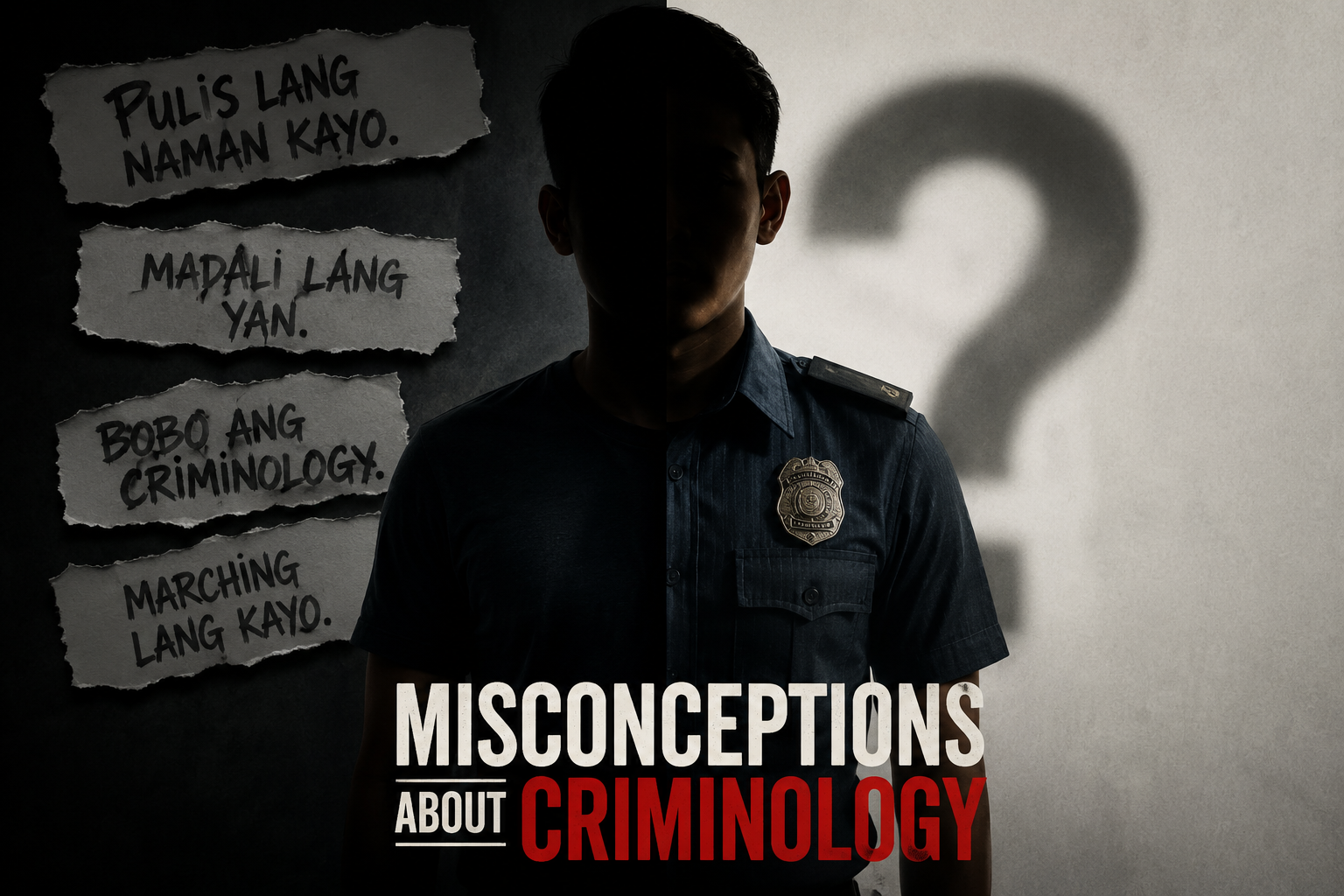
“Criminology? Pulis lang naman ang bagsak niyan.” “Madali lang naman ang Criminology.” “Bobo ang mga nag-Criminology.” “Puro marching at formation lang naman kayo.” “Kapag hindi ka nag-pulis, sayang ang course mo.” “Bakit kailangan ninyo ng research, statistics, English, at technology?”
We have probably heard some version of these statements before. Sometimes they are jokes, sometimes insults, and sometimes they simply come from people who genuinely do not understand the discipline. The problem is that when stereotypes are repeated long enough, they begin to shape public perception. Worse, even Criminology students and graduates can eventually internalize them. We begin measuring success according to who entered the PNP, who wears a uniform, or who obtained a particular rank. We begin thinking that subjects outside policing are merely additional requirements to pass. Some even begin asking why Criminology students need research, statistics, communication, psychology, sociology, information technology, and other fields when, according to the stereotype, “magpupulis lang naman.” Perhaps the real problem is not that Criminology lacks depth. The problem is that many people have been shown a very small portion of a much larger discipline.
1. “BOBO ANG MGA NAG-CRIMINOLOGY.”
This is probably one of the most insulting stereotypes attached to the program. Criminology students are sometimes portrayed as academically weak, poor in English, incapable of research, dependent on memorization, or more concerned with physical activities, marching, drills, and formations than intellectual development. We can become angry whenever we hear this, but anger alone will never destroy the stereotype. The strongest response is competence. Look at what the discipline actually requires. Law demands comprehension, interpretation, reasoning, and an understanding of rights, obligations, procedures, and criminal liability. Investigation requires observation, interviewing, documentation, logical reasoning, reconstruction, evidence evaluation, and the ability to distinguish facts from assumptions. Criminalistics introduces scientific approaches to physical evidence. Criminal sociology and psychology require us to examine human behavior, social structures, deviance, criminal motivation, victimization, and the circumstances surrounding crime. Corrections requires us to understand punishment, rehabilitation, institutions, offender management, and reintegration. Research requires methodology, statistics, analysis, interpretation, and academic communication. Intelligence requires information gathering, evaluation, analysis, and judgment. Crime prevention requires us to identify risks, recognize patterns, understand opportunities, and design interventions.
These are not merely physical competencies. They are intellectual ones. At the same time, we should be willing to confront an uncomfortable truth: having a multidisciplinary curriculum does not automatically make every student competent. A student can still choose to memorize without understanding, avoid reading, refuse to improve communication skills, disregard research, ignore technology, and study only enough to pass. That is true in Criminology just as it is true in other disciplines. If we want people to stop treating Criminology as intellectually inferior, then we should produce graduates capable of demonstrating otherwise. We should be able to analyze information, articulate arguments, conduct research, understand evidence, communicate professionally, use technology responsibly, and explain crime beyond memorized textbook definitions. Instead of endlessly insisting that Criminology students are not “bobo,” perhaps the profession should make that stereotype increasingly impossible to believe.
2. “CRIMINOLOGY IS JUST TRAINING TO BECOME A POLICE OFFICER.”
There is absolutely nothing wrong with wanting to become a police officer. Police service is an honorable profession, and the PNP remains one of the most visible career destinations for Criminology graduates. The misconception begins when people confuse one career destination with the entire discipline. PNP is a career path where criminological knowledge is applied. It is not the definition of Criminology. The same principle applies to the BFP, BJMP, Bureau of Corrections, PDEA, Probation and Parole Administration, NBI, private security, academe, forensic practice, research, and other professional environments. These are not separate explanations of what Criminology is. They are areas where particular components of our multidisciplinary education become more specialized.
This explains something that many students only appreciate after graduation: we are not expected to apply every subject we studied in college every single day. Undergraduate Criminology gives us a broad professional foundation because, while we are students, we are still learning the different dimensions of crime and the criminal justice system. Once we enter a particular career, certain portions of that foundation become more relevant than others, and we begin developing specialization through agency training, professional experience, advanced education, certifications, continuing professional development, and actual practice. In other words, college provides breadth; professional practice gradually develops depth.
Consider the BFP. Criminology students encounter Fire Technology and Arson Investigation, together with investigative, legal, administrative, and public-safety concepts. A graduate who eventually enters the fire service will naturally deepen competencies related to fire protection, fire safety, fire investigation, prevention, administration, and other responsibilities relevant to the agency. That does not mean every criminologist must become a fire investigator. It means the undergraduate program provides exposure to an area that may later become someone's professional specialization.
The same is true for the BJMP and Bureau of Corrections. Criminology students study institutional corrections, offender management, rehabilitation, and approaches associated with correctional treatment, including concepts encountered in programs such as the Therapeutic Community Modality Program. A criminologist who enters jail or prison management will naturally develop much deeper knowledge of custodial operations, security, inmate or person-deprived-of-liberty management, rehabilitation, reformation, and institutional corrections than someone who chooses another career. Meanwhile, a criminologist entering the Probation and Parole Administration moves toward non-institutional or community-based corrections, where supervision, rehabilitation, reintegration, case management, and community-based treatment become more central.
The same pattern appears in drug enforcement. Students encounter Drug Education and Vice Control and related concepts concerning illegal drugs, prevention, investigation, law, and enforcement. A criminologist who later joins PDEA may develop much deeper expertise in drug intelligence, investigation, interdiction, enforcement, prevention, and other specialized operations. In the PNP, meanwhile, the broad exposure to policing, patrol operations, criminal investigation, traffic management, intelligence, criminal law, evidence, police administration, community relations, and crime prevention becomes relevant in different ways depending on assignment. Even within the police service, there is no single specialization called “police work.” Patrol, investigation, intelligence, traffic enforcement, community affairs, cybercrime investigation, specialized operations, administration, and forensic support require different competencies.
The NBI provides another useful example. A criminologist entering investigative work may eventually encounter specialized areas involving organized crime, cybercrime, fraud, trafficking, financial crimes, intelligence, forensic investigation, and other complex cases depending on assignment and training. An investigator dealing with cybercrime will develop competencies very different from someone investigating another category of offense. The important point is that the career does not suddenly become the definition of Criminology. The career becomes the environment in which a criminologist develops specialization.
3. “KUNG HINDI NAMAN MAGAGAMIT LAHAT NG SUBJECTS, BAKIT PA NATIN PINAG-AARALAN?”
This question misunderstands the purpose of undergraduate professional education. We do not study broadly because every graduate is expected to perform every possible criminological function simultaneously. We study broadly because crime itself is complex and because students need to understand the system before specializing in one part of it. A criminologist entering corrections still benefits from understanding criminal behavior and criminal law. An investigator benefits from psychology and sociology because investigations involve human beings, motives, relationships, memory, deception, emotions, and social environments. A police officer benefits from understanding corrections because arrest is only one part of the criminal justice process. A corrections practitioner benefits from understanding investigation and evidence because the people entering correctional institutions passed through investigative and judicial processes. A security practitioner benefits from criminological theories and crime prevention because security is not simply about guards and gates; it involves identifying threats, vulnerabilities, opportunities, and risks before incidents occur.
Think of undergraduate Criminology as a map. You are shown the larger territory so that later you can decide which part of that territory you will explore deeply. A person specializing in fire investigation does not need the same depth of knowledge as a cybercrime investigator. A probation officer does not perform the same daily functions as a police investigator. A forensic examiner does not perform the same work as a jail officer. An academic researcher does not have the same responsibilities as an intelligence practitioner. Yet all of them can benefit from understanding how their specialized functions relate to crime, offenders, victims, evidence, justice, corrections, and prevention. We study broadly not because we will use everything at the same time, but because specialization without foundations produces professionals who understand their task but not the larger problem their task is supposed to address.
4. “CRIMINOLOGY HAS NO REAL ACADEMIC DEPTH.”
This misconception becomes difficult to sustain when we return to the questions criminology actually attempts to answer. Why do people commit crimes? Why do individuals exposed to similar conditions behave differently? Why do certain places experience more crime than others? Why do particular people or institutions become targets? What makes an offender choose one victim instead of another? How does opportunity influence offending? How do family, peers, environment, inequality, culture, technology, psychology, and individual decision-making interact? Why do some offenders stop offending while others continue? Which correctional interventions actually reduce recidivism? Which crime-prevention strategies work, and which merely make us feel safer without producing meaningful results?
There are no simple answers to these questions. Poverty alone cannot explain crime because most poor people do not become criminals. Opportunity alone cannot explain it because people facing similar opportunities make different choices. Psychology alone cannot explain crime because behavior develops within families, communities, institutions, cultures, and social environments. Law tells us what conduct society has prohibited, but law alone does not explain why prohibited behavior occurs. This is why Criminology is inherently multidisciplinary. It draws from sociology, psychology, law, forensic science, public administration, statistics, research, technology, and other areas because crime itself is a multidimensional human problem.
5. “CRIMINOLOGY IS ONLY ABOUT CATCHING CRIMINALS.”
This may be one of the most serious misconceptions because it reduces the profession to reacting after harm has already occurred. Yes, apprehending offenders is important. Investigation is important. Prosecution is important. Corrections is important. But when an offender is arrested, somebody may already have been robbed, assaulted, defrauded, exploited, abused, or killed. If our concept of Criminology begins only after a crime happens, then we are always arriving after someone has already become a victim.
Criminology asks a deeper set of questions. Why did this crime happen? What circumstances created the opportunity? Why was this particular victim targeted? What environmental, social, psychological, economic, or technological conditions contributed to the event? Could warning signs have been recognized? Could the opportunity have been reduced? What can institutions or communities change to make recurrence less likely? How should offenders be treated and rehabilitated? Which interventions actually work? This is why we study crime causation, victimology, investigation, criminalistics, corrections, rehabilitation, security, research, and crime prevention. We are not studying criminals because criminals are fascinating. We study criminal behavior because understanding why and how crimes happen helps society develop better ways to prevent them.
That distinction is fundamental. Catching a criminal after ten people have already become victims is necessary for justice, but preventing those ten people from becoming victims in the first place is an equally important criminological objective. Prevention requires knowledge. Knowledge requires investigation, observation, theory, research, evidence, and continuous evaluation. The ultimate value of criminology should therefore not be measured only by the number of offenders apprehended, but also by its capacity to contribute to reducing crime and victimization.
6. “RESEARCH, ENGLISH, STATISTICS, AND COMMUNICATION ARE NOT REALLY IMPORTANT.”
These become extremely important once we stop treating criminologists merely as future uniformed personnel and start treating them as professionals expected to analyze problems and produce defensible conclusions. How can we determine whether a crime-prevention intervention is effective without research? How can we identify patterns without data? How can we establish whether two factors are meaningfully associated without statistics? How can an investigator communicate findings without clear writing? How can a professional conduct a proper interview without effective questioning and listening? How can criminologists recommend policy if they cannot explain the evidence behind their recommendations?
Research moves us from “Sa tingin ko” toward “The evidence suggests.” That transition matters. Experience remains valuable, but personal experience should not automatically be treated as universal truth. A criminologist should know how to ask meaningful questions, gather information systematically, evaluate sources, analyze evidence, recognize limitations, and communicate conclusions responsibly. English itself is not the measure of intelligence, nor should fluency be used to demean students, but professional communication is indispensable. Reports, affidavits, research papers, case narratives, presentations, interviews, testimony, policies, and inter-agency communication require clarity and precision. An excellent observation that cannot be properly documented can lose much of its value.
7. “TECHNOLOGY HAS LITTLE TO DO WITH CRIMINOLOGY.”
This misconception is becoming increasingly impossible to defend because criminals themselves have already embraced technology. Fraud can occur without the offender and victim ever meeting. Phishing can manipulate a person thousands of kilometers away. Criminals can use fake identities, compromised accounts, encrypted communication, digital payment systems, cryptocurrencies, social-media platforms, malicious links, electronic documents, and artificial intelligence. Exploitation can occur online. Extortion can be conducted through messaging applications. Financial scams can cross jurisdictions within minutes. Artificial intelligence can generate realistic photographs, fabricated documents, cloned voices, and deepfake videos.
The traditional offender may leave fingerprints, footprints, weapons, fibers, documents, and eyewitnesses. The modern offender may leave those things plus digital footprints such as metadata, account activity, electronic transactions, device artifacts, CCTV recordings, online communications, location information, and cloud records. This does not mean every criminologist must become a programmer, cybersecurity engineer, or digital forensic examiner. Those are specialized professions and competencies that require appropriate education and training. But it does mean that technological ignorance is increasingly incompatible with modern investigative awareness. Criminologists should understand enough about the digital environment to recognize when technology is relevant, what forms of digital evidence may exist, why preservation matters, when specialist assistance is required, and how technology changes criminal opportunities and victimization.
8. “KAPAG NAG-ARAL KA NG TECHNOLOGY, PSYCHOLOGY, LAW, BUSINESS, O IBANG FIELD, LUMALAYO KA NA SA CRIMINOLOGY.”
This misconception ignores the multidisciplinary character of crime itself. A cyberfraud case can involve criminology, psychology, information technology, finance, law, and cybersecurity simultaneously. An organized criminal network may involve illegal drugs, money laundering, corruption, violence, technology, communication systems, and international movement. A fraud investigator may need to understand financial records. A cybercrime investigator needs technological literacy. A crime-prevention specialist may benefit from psychology, sociology, architecture, urban planning, education, and data analysis. An intelligence practitioner may draw from behavioral analysis, statistics, geopolitics, communication, and technology.
Crime does not care which college department owns a particular body of knowledge. Criminals will use whatever works. Criminologists therefore should be willing to learn from other disciplines when that knowledge helps us understand, investigate, explain, or prevent crime. The better question is not “Criminology pa ba iyan?” but “How can this knowledge make us better at understanding and responding to crime?” Interdisciplinary learning does not necessarily dilute Criminology. Properly applied, it strengthens it.
9. “KAPAG LICENSED CRIMINOLOGIST KA NA, TAPOS NA ANG PAG-AARAL.”
Passing the Criminologists Licensure Examination is a major professional achievement, but a professional license should represent the beginning of professional responsibility rather than the end of learning. No licensure examination can permanently prepare someone for everything that will happen during a twenty- or thirty-year career. Laws change, technologies change, criminal methods evolve, investigative techniques improve, new research challenges old assumptions, and new forms of victimization emerge.
Consider how quickly artificial intelligence has changed questions surrounding identity, deception, fraud, authenticity, and digital evidence. Consider how social media changed communication, victim targeting, misinformation, harassment, exploitation, and investigation. Consider how smartphones transformed the amount of potential evidence people carry every day. A criminologist trained decades ago could not have been taught every contemporary technological issue because many of these technologies did not yet exist. Professional competence therefore requires continuing learning. A license certifies qualification at a particular point. It should never become permission to become professionally stagnant.
10. THE CAREER PATHS ARE SPECIALIZATIONS. CRIMINOLOGY IS THE FOUNDATION.
This is perhaps the most important misconception to correct. When a Criminology graduate enters the PNP, that person begins developing deeper competencies relevant to policing and whatever assignment eventually follows. When another enters the BFP, fire protection, prevention, administration, and fire or arson investigation become increasingly relevant. When another enters BJMP or BuCor, institutional corrections, custodial management, security, rehabilitation, reformation, and programs such as the Therapeutic Community Modality become more central. When another works with probation and parole, non-institutional or community-based corrections becomes the professional environment. When another enters PDEA, drug enforcement, intelligence, investigation, interdiction, prevention, and drug-related laws become increasingly specialized. When another enters investigative agencies such as the NBI, that person may eventually develop expertise in particular investigative domains such as organized crime, cybercrime, fraud, trafficking, or other complex offenses depending on assignment and institutional training.
Even within the same agency, specialization continues. Not every police officer is an investigator. Not every investigator handles cybercrime. Not every forensic practitioner examines the same type of evidence. Not every intelligence officer performs the same function. Not every corrections practitioner performs identical duties. This is why saying “Criminology equals police” makes little sense. Even “police” itself contains numerous specialized functions.
Our undergraduate education is therefore not supposed to turn us immediately into masters of every area we encounter. Fire investigation, institutional corrections, community corrections, drug enforcement, criminal investigation, intelligence, criminalistics, policing, security, research, and other subjects introduce us to major areas within the broader discipline. Professional practice then determines which of those foundations we deepen. We begin broad because Criminology is broad. We become specialized because professional practice requires depth.
RA 11131 AND THE WIDER PROFESSIONAL IDENTITY OF THE CRIMINOLOGIST
Republic Act No. 11131, or the Philippine Criminology Profession Act of 2018, reinforces this broader understanding of the profession. Its scope of practice is not confined to police service. Section 5 recognizes areas involving law enforcement and quasi-police functions, teaching professional criminology subjects, scientific crime detection, corrections and rehabilitation, research and consultancy, private investigation, security, and related professional activities. Its other provisions also recognize numerous positions associated with investigation, intelligence, forensic work, corrections, probation and parole, security, fire service, policing, jail management, and the wider criminal justice and public-safety environment.
This matters because the law itself gives us a much larger picture than the stereotype. A criminologist may serve in uniformed law enforcement, but another may work in investigation, corrections, security, research, education, scientific crime detection, consultancy, intelligence, or another related area. These career directions do not compete for the right to be called “real Criminology.” They represent different applications and specializations emerging from a common multidisciplinary foundation.
More importantly, RA 11131 recognizes a profession capable of development. That principle becomes especially significant in the digital age because the nature of crime is changing faster than the boundaries of traditional academic subjects. Cybercrime, artificial intelligence, deepfakes, digital fraud, cryptocurrency, electronic evidence, online exploitation, social engineering, identity theft, cloud technology, and future technologies will continue creating new problems for investigators, researchers, policymakers, security practitioners, and crime-prevention professionals.
The solution is not to abandon traditional Criminology. The solution is to build upon it. We still need criminal law, investigation, criminalistics, policing, corrections, criminal sociology, victimology, ethics, intelligence, and crime prevention. But those foundations increasingly need to interact with digital literacy, research competence, critical thinking, data analysis, cybersecurity awareness, technological understanding, effective communication, and interdisciplinary collaboration. That is not turning Criminology into Information Technology, psychology, law, or another discipline. It is allowing criminologists to use relevant knowledge from those fields to better understand the changing problem we were trained to study.
And this brings us back to the heart of Criminology. Strip away the uniforms, ranks, agency names, examinations, acronyms, and career titles, and we return to a fundamental purpose: the study of crime and criminal behavior so that we can understand the problem and develop better responses to it. We study offenders to understand why and how they offend. We study victims to understand vulnerability and victimization. We study environments to understand opportunities for crime. We study investigation to determine what happened and establish facts through evidence. We study corrections to understand punishment, rehabilitation, and reintegration. We study law because justice requires rules and due process. We study research because assumptions are not enough. We study technology because crime increasingly operates within technological environments. We study prevention because the best response to victimization is not always what happens after the crime. Sometimes it is what prevents the crime from happening at all.
That is why a criminologist is multidisciplinary before becoming specialized. The police officer, fire officer, jail or corrections practitioner, probation and parole practitioner, drug enforcement professional, investigator, intelligence practitioner, forensic practitioner, security professional, researcher, and educator may eventually develop very different expertise. Their daily work may look completely different. They may use different portions of what they learned in college. Yet underneath those specializations is the same intellectual foundation: an attempt to understand crime, criminals, victims, the systems that respond to them, and the interventions that can protect society.
So when somebody says, “Criminology? Pulis lang naman.” We should not merely answer, “Hindi.” We should understand enough about our own profession to explain why. Police service is one specialization. Corrections is another. Fire protection and investigation provide another professional direction. Drug enforcement is another. Community corrections, intelligence, security, scientific crime detection, research, education, private investigation, and emerging areas involving cybercrime and digital evidence provide still more directions. Different careers require different competencies, and no criminologist is expected to become an expert in all of them.
Criminology gives us the foundation. Our careers determine where we specialize. Continuous learning determines how good we eventually become.
The badge matters. The uniform is honorable. The license matters. But none of them alone defines Criminology. The discipline is much bigger because the problem it attempts to understand is much bigger. Crime changes with society. Criminals adapt to opportunities. Technology creates new vulnerabilities. Evidence evolves. Victimization takes new forms. If those we study continue to learn, adapt, and innovate, then those tasked with understanding them cannot afford to remain intellectually stagnant.
Perhaps this is the misconception we ultimately need to destroy: that Criminology is a small course leading to a small collection of jobs. It is better understood as a multidisciplinary study of an extraordinarily complex social problem from which different professional specializations emerge.
We study crime. We study criminals. We study victims. We study evidence, behavior, institutions, justice, corrections, security, and the conditions that allow crime to occur. We do all of these not merely so that somebody can make an arrest after another person has already suffered, but so that our accumulated knowledge can help society investigate more accurately, respond more intelligently, rehabilitate more effectively, and most importantly, develop solutions that prevent people from becoming victims in the first place.
That is the larger purpose.
That is Criminology.