
MORE THAN AN IMAGE
By Criminolohenyo · August 12, 2026
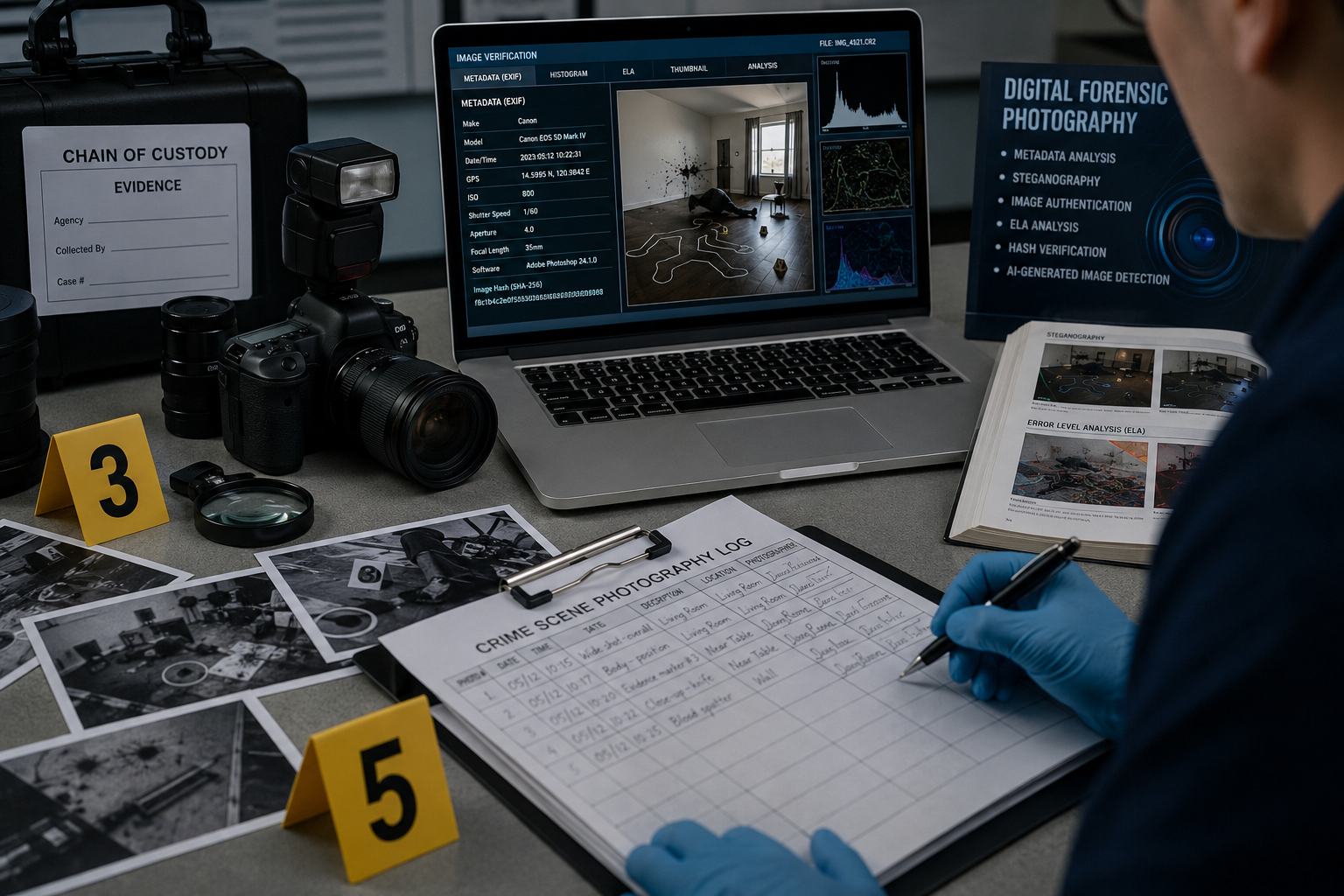
A camera no longer captures only what the eyes can see, it also captures evidence hidden beneath the image.
Forensic Photography has long been an essential component of crime scene investigation. Students are trained to properly document crime scenes, preserve evidence through photographs, and present visual documentation in court.
However, in today's digital age, a photograph is no longer just an image, it is digital evidence. Every file contains information beyond what is visible. Embedded metadata can reveal when, where, and how a photograph was taken. Hidden information can be concealed through steganography.
Image editing software can alter photographs without leaving obvious visual traces. More importantly, with the rapid advancement of Artificial Intelligence, investigators are now confronted with a new challenge:
Is the image real, manipulated, or entirely AI-generated?
This question is becoming increasingly important in criminal investigations, where a single fabricated image can mislead investigators, influence public opinion, or even become false evidence in legal proceedings.
If we truly want to prepare future criminologists for modern investigations, Digital Forensic Photography must become part of the Forensic Photography curriculum.
Students should learn metadata (EXIF) examination, digital chain of custody, steganography detection, image authentication, error level analysis (ELA), hash verification, reverse image searching, compression artifact analysis, AI-generated image detection, deepfake recognition, and the forensic validation of digital photographs for court presentation.
They should be trained not only to capture crime scene photographs, but also to scientifically determine whether an image has been edited, manipulated, fabricated, or generated entirely by Artificial Intelligence.
In an era where anyone can create convincing fake photographs within seconds, the authenticity of digital images can no longer be assumed, it must be forensically verified.
The future criminologist should not simply ask,
"What does this photograph show?"
but also,
"Can this photograph be trusted?"
Because in modern investigations, the integrity of a digital photograph may be just as important as the evidence it appears to depict.